
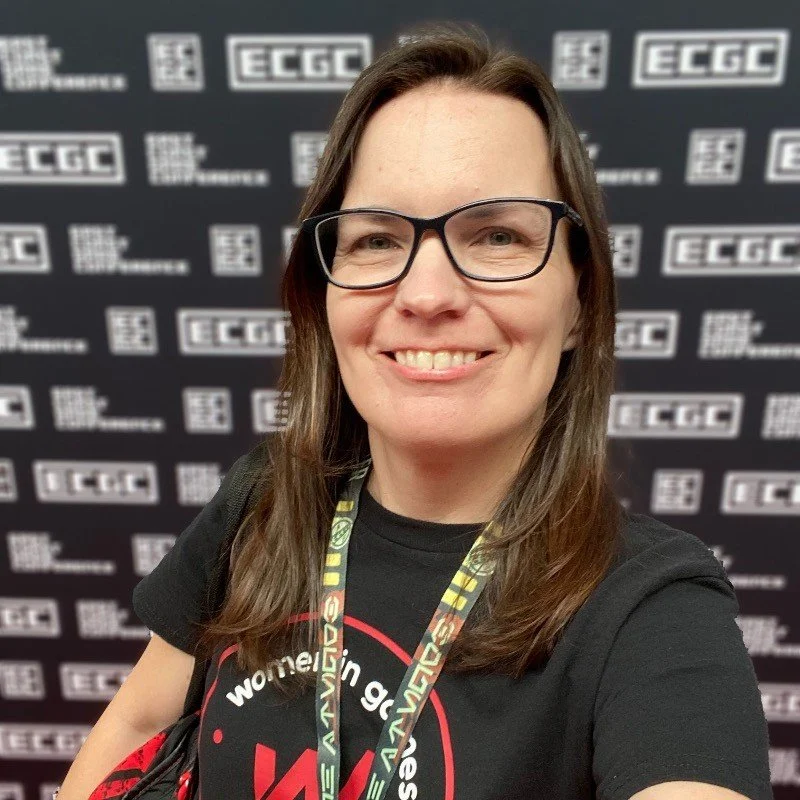
ABOUT Janie:
Janie Hughes is the CEO and co-founder of Bingo Bard, a web-based social gaming platform designed to transform events and shared experiences into interactive bingo games.
Bingo Bard allows organizers to build customized games around conferences, communities, live events, podcasts, and other experiences while encouraging participants to engage with the environment and each other.
Janie is also a Women in Games Ambassador and former chair of the IGDA North Carolina Triangle chapter, where she helped rebuild a dormant community into an active regional network connecting game developers, artists, programmers, marketers, producers, and other industry professionals.
Before moving deeper into games and entrepreneurship, Janie spent years working in corporate environments and managing teams, experience that now shapes how she thinks about leadership, community building, team dynamics, communication, and creating structures that help people work together.






Here’s a glimpse of what you’ll learn:
How Bingo Bard turns shared experiences into interactive social games
Why Janie believes in the "power of friendship"
How gamification can make events, podcasts, conferences, and communities more engaging
Why simple games can create surprisingly strong social connections
How games can give people common ground without requiring them to agree on everything
Why casual acquaintances play an important role in our social lives
How games can give people a break from an increasingly divided world
Why play can act as an equalizer between people with different backgrounds
How Janie and her husband turned a Thanksgiving bingo joke into a real product
Why community involvement helped shape Bingo Bard
How the Triangle Interactive Arts Collective supports local indie developers
Why local playtesting communities matter to indie game development
How Bingo Bard evolved through experiments at GDC
What an Apple Vision Pro sighting taught Janie about shared experiences
Why creating small moments of ridiculous fun can make stressful events more memorable
Why "simple" user experiences are usually much harder to design than they appear
Why Bingo Bard eventually needed tutorials for something that seemed obvious
How playtesting reveals assumptions designers don't realize they're making
Why familiar mechanics like bingo and word games make games more accessible
What Wordle and other casual games teach us about simple game design
Why millions of people play games without identifying themselves as "gamers"
How accessibility expands the potential audience for games
Why brands become more resilient when people genuinely care about the community around them
What Janie learned rebuilding the IGDA North Carolina Triangle chapter
Why communities often collapse when one key organizer steps away
How to recruit volunteers without making participation feel overwhelming
Why giving people small responsibilities can make them feel more connected
How assigning someone a role can reduce social anxiety at networking events
Why succession planning is essential for communities that want to last
How to hand leadership to the next person without losing institutional knowledge
Why communities need fresh leadership, fresh events, and fresh perspectives
How long-running communities can accidentally become cliquey or gatekeepy
Why defining a "real game developer" too narrowly damages a community
Why different people need different roles in volunteer organizations
How mixing social events, educational talks, playtests, and other formats keeps communities alive
What Janie's corporate management experience taught her about team dynamics
The four stages of team development: forming, storming, norming, and performing
Why many teams never escape the storming stage
How clear communication and role ownership help teams move forward
Why people need to understand and accept their role, not simply be assigned one
Why realizing conflict is normal can help teams stop treating every disagreement like a crisis
The games that shaped Janie and Carl, from Atari and Zelda to Baldur's Gate 3
In This Episode…
Carl sits down with Janie Hughes, CEO and co-founder of Bingo Bard, a web-based social gaming platform that turns events and shared experiences into interactive bingo games designed to drive engagement, connection, and community. Janie is also a Women in Games Ambassador and former chair of the IGDA North Carolina Triangle chapter, where she helped relaunch a dormant local community and grow it into an active regional hub.
Together they explore why play can create meaningful connections between people who may otherwise have very little in common, how gamification can strengthen brands and communities, and what it actually takes to build a community that survives beyond its original organizers. Janie also shares lessons from launching Bingo Bard, playtesting deceptively simple experiences, creating accessible games, recruiting volunteers, succession planning, avoiding community gatekeeping, and helping teams move from chaos toward real collaboration.
Resources Mentioned in this episode:
🎮 Bingo Bard
🎯 Play the Pixel Retentive Bingo Game
https://bingobard.com/epic-made
https://www.linkedin.com/in/janiehughes/
Sponsor for this episode...
This episode is brought to you by Epic Made.
Epic Made creates entertainment-quality animation, digital art, and graphic design to elevate brands and build fandom.
We are a collective of senior-level artists across multiple disciplines, producing trailers, key art, social campaigns, branded storytelling, and motion systems for entertainment, gaming, and pop culture brands. Our work has supported major networks and studios, including SYFY and Nickelodeon.
To learn more, visit www.epicmade.net or email hey@getepicmade.com.
If this episode resonated with you, share it with someone who would find value in the conversation